Virginia's GS-5 Large Load Class Starts January 1: What the 25 MW Threshold Means for Industrial Facilities
Virginia has made the large-load question concrete: know where your facility stands before the tariff decides for you.
Published October 2026 · Discovery Energy
Dominion Energy Virginia's new GS-5 large-load rate class takes effect January 1, 2027. It applies to customers with at least 25 megawatts of demand and a load factor of at least 75 percent.
That threshold is designed for data centers and other high-utilization loads. But industrial facilities should not dismiss it as a data center issue. Expansion plans, electrification, on-site generation, and multiple facilities in the same utility territory can change a customer's load profile quickly.
Virginia regulators have answered the data center cost question in a tariff: large loads will be expected to pay the costs they cause.
If your facility is near the threshold, the rules governing the data center next door may soon govern you.
What Virginia approved: the GS-5 large-load rate class
The Virginia State Corporation Commission (SCC) created GS-5 in its November 2025 final order in Dominion's biennial rate review, in response to accelerating load growth and the concentration of data center development in Northern Virginia.
According to the SCC, the class will include all new or existing customers that meet its thresholds, so their rates are set separately from other customers. The SCC also directed Dominion to propose alternative cost allocation methods in future proceedings and to file standards for its large-load interconnection queue.
The two thresholds
A customer must generally meet both conditions:
- At least 25 MW of demand
- At least a 75 percent load factor
Load factor compares average demand with peak demand. A 75 percent load factor indicates a relatively flat, high-utilization load.
That is typical of a data center. It can also resemble the profile of a continuously operating chemical process, advanced manufacturing line, industrial refrigeration system, or large electrification project.
A facility that peaks sharply for short periods may not resemble the GS-5 profile. A facility that operates close to full output around the clock is a different financial and regulatory risk.
The 14-year contract obligation
New GS-5 customers taking service on or after January 1, 2027 will generally have to contract for at least 14 years. The purpose is to give Dominion a long enough recovery period for the generation, transmission, distribution, and interconnection infrastructure required to serve a very large new load.
The structure also includes collateral for new customers that lack sufficient credit, and exit fees. These provisions are intended to protect other customers from stranded infrastructure costs if a large customer reduces its load, delays a project, or leaves before the utility has recovered its investment.
Minimum demand charges
The GS-5 structure includes minimum demand obligations:
- 85 percent of contracted transmission and distribution demand
- 60 percent of contracted generation demand
This is a material change in how a large customer must think about capacity planning.
A customer that contracts for 100 MW may owe transmission and distribution demand charges on at least 85 MW even if its actual demand falls below that level. Generation minimums would apply at 60 MW under the same structure.
View the chart data
| Component | Minimum share | Billed at least |
|---|---|---|
| Contracted demand | 100% | 100 MW contracted |
| Transmission and distribution demand | 85% | 85 MW |
| Generation demand | 60% | 60 MW |
You can be billed for capacity you contract but do not use.
Why GS-5 matters even if your facility is not yet at 25 MW
Most individual industrial plants will not reach 25 MW of demand. That does not make the tariff irrelevant.
Multi-site load may change the analysis
Facilities that are geographically close or served within the same Dominion territory may need to examine whether their loads can be considered together under applicable tariff rules. Campus treatment and related utility definitions can affect whether a customer approaches the threshold.
Do not assume that separate meters automatically mean separate financial exposure. Review the utility's definitions, service agreements, ownership structure, and operating relationships before making that assumption.
Expansion can cross the line faster than expected
A plant may move toward the threshold through:
- New production lines
- Electric boilers or process heat
- Industrial refrigeration
- Expanded wastewater treatment
- Warehouse automation
- Hydrogen or other process electrification
- Battery charging infrastructure
- New buildings or production campuses
A project that adds 5 MW or 10 MW may not appear significant in isolation. Across several facilities, it can materially change the portfolio's demand profile and procurement risk.
On-site generation does not automatically eliminate tariff exposure
Backup generation, combined heat and power, solar, batteries, and demand response can alter measured demand. They do not automatically eliminate the need to understand the applicable tariff or the contracted obligations.
The financial result depends on how the utility measures demand, whether generation operates during the relevant intervals, how interconnection is structured, and whether the customer remains responsible for minimum contracted demand.
This is where load forecasting matters. A forecast should not only estimate annual kilowatt-hours. It should model peak demand, interval behavior, load factor, contracted capacity, ramp timing, and the cost of underutilization.
Who can choose a supplier in Virginia, and how capacity reaches the bill
Virginia is not a full retail-choice state, and that changes how industrial buyers should think about procurement.
Most Dominion commercial and industrial customers buy bundled service from Dominion at rates the SCC approves. For them, PJM capacity and other generation costs are recovered through those regulated rates and riders, not through a supplier contract.
The exception is large customers. Under HB 921, effective July 1, 2026, any nonresidential customer of Dominion or Appalachian Power whose peak demand exceeds 5 MW can buy electricity from a licensed competitive supplier. The law also shortened the notice required to return to utility service from five years to 18 months.
That creates two different situations:
- Facilities on Dominion bundled service should focus on rate classification, demand determinants, riders, and whether a load change could move them into GS-5.
- Facilities above 5 MW that buy from a competitive supplier also need to know how the contract treats PJM capacity, transmission, and other pass-through components.
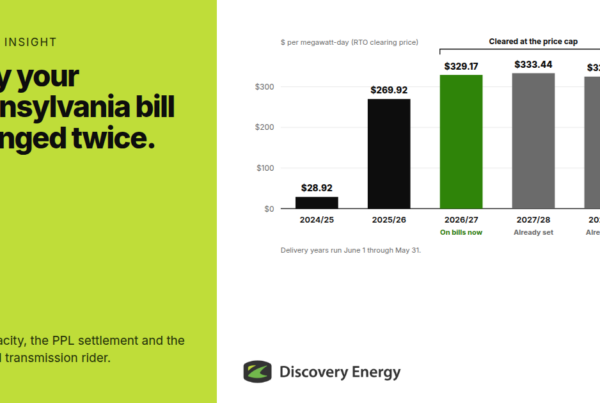
For either group, PJM's 2026/2027 capacity auction cleared at $329.17 per MW-day, compared with $28.92 per MW-day for 2024/2025, and the next two auctions also cleared at the price cap. That is not an energy commodity price. It is a capacity market cost associated with maintaining resource adequacy, and it reaches the bill one way or another.
A PJM-wide price is not a facility-level cost. The utility, rate class, contract language, demand profile, and billing determinants all matter.
The regional pattern: Virginia and Maryland are moving in parallel
Virginia is not acting in isolation.
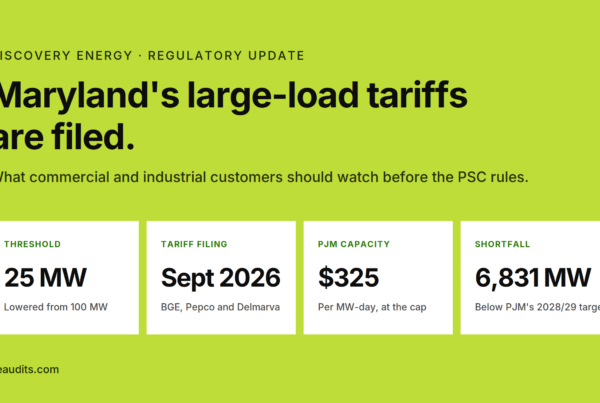
Maryland's Utility RELIEF Act, enacted in 2026, lowered the threshold for mandatory large-load rate schedules from 100 MW with an 80% load factor to 25 MW with a 60% load factor. It requires utilities to submit large-load rate schedules to the Maryland Public Service Commission and directs the commission to create a registration framework for new or expanded large loads. The commission is working through the design, and consumer advocates are pressing for strong protections against cost shifting.
The regional direction is clear:
- Large loads will face greater registration and documentation requirements.
- Utilities are being pushed to verify that projected demand is real.
- Customers may be required to provide financial security.
- Infrastructure and capacity costs are increasingly being assigned to the loads driving them.
- On-site generation, clean capacity, and interruptible service may affect interconnection treatment.
This matters for companies operating across Virginia, Maryland, Pennsylvania, Ohio, Illinois, New Jersey, and Indiana. The PJM market is regional, but the tariff response is state-specific.
What a Virginia facility can actually do
Start with a utility audit.
It is nearly impossible to fix what you do not understand. Before changing suppliers, installing generation, signing a long-term service agreement, or accepting a new tariff classification, verify how the facility is being billed today. A Discovery Energy utility bill audit should establish the baseline.
Audit the current rate classification
Confirm that the facility is on the correct Dominion rate schedule and that the utility is applying the tariff as written. Review whether the customer is approaching the GS-5 demand and load factor thresholds.
The audit should examine:
- Rate classification
- Contracted demand
- Measured demand
- Distribution demand
- Transmission demand
- Generation demand
- Load factor
- Demand ratchets
- Billing determinants
- Meter multipliers
- Service voltage
- Applicable riders
- Non-bypassable charges
- Government utility exemptions
- Historical refunds or credits
Utility billing errors are not limited to arithmetic mistakes. A facility can be billed correctly under the wrong rate class, or a tariff can be applied incorrectly for years without producing an obviously unreasonable invoice.
Review the contract structure
A 14-year commitment changes the risk profile of a project. Before signing, model:
- Minimum transmission and distribution demand
- Minimum generation demand
- Collateral requirements
- Exit fees
- Ramp-up assumptions
- Expansion timing
- Partial-load scenarios
- Production interruption
- Facility closure or relocation
- Changes in load factor
- On-site generation performance
The right question is not simply, "What is the rate?" The right question is, "What will this facility owe under several operating scenarios over 14 years?"
If you buy from a competitive supplier, verify how capacity is treated
For facilities above 5 MW that buy from a competitive supplier, capacity may be passed through separately or included in a fixed-price product. The contract must state the treatment clearly. Ask whether the supplier is fixing:
- Capacity
- Transmission
- Ancillary services
- Renewable compliance costs
- PJM-related adjustments
- Other pass-through components
Utility delivery charges remain with Dominion regardless of supplier. A contract advertised as fixed may still leave significant components floating. A utility audit and contract review should reconcile the supplier invoice with the utility bill and the executed agreement.
Practical actions for Virginia industrial customers
-
Model GS-5 economics before signing anything
Build a 14-year model using actual interval data, projected demand, load factor, minimum demand charges, collateral, exit fees, and expansion scenarios.
-
Audit before you procure
Correct rate errors, demand calculations, meter multipliers, riders, and billing determinants before using the bill as a planning or procurement baseline. Discovery Energy's utility audits are contingency-based. There is no upfront audit fee. Under the agreed terms, Discovery Energy is paid when the client receives qualifying refunds, credits or realized savings.
-
Map your proximity to 5 MW and 25 MW
Review every Dominion-served facility, planned expansion, and electrification project. Note which sites exceed 5 MW and can choose a supplier, and which could approach GS-5, including related locations where aggregation or campus treatment may apply.
-
If you can shop, use clear Buy, Wait, or Hedge guidance
For facilities above 5 MW, do not wait for GS-5 to take effect before evaluating supply risk. If the facility's load is stable and a contract provides transparent capacity treatment, hedge. If demand is uncertain because of a pending expansion, wait on volume commitments but secure the information needed to act. If the load profile is verified and market conditions are favorable, buy through a competitive RFP. Factor in the 18-month notice required to return to Dominion service.
-
Time procurement around PJM market conditions
Discovery's energy procurement process uses competitive RFPs, apples-to-apples bid comparisons, market timing, and contract tracking across deregulated markets. Procurement should follow the facility's risk tolerance, not an arbitrary calendar deadline.
-
Benchmark Virginia facilities against the portfolio
Compare cost per kW, cost per kWh, load factor, peak demand, capacity treatment, and tariff classification across similar sites. Differences often identify a billing or contract issue.
-
Create one integrated view in TaraBase
Audit findings, bills, contracts, demand data, savings, and renewal dates should flow into a single platform. Discovery Energy's TaraBase reporting platform consolidates bills, usage, contracts, savings, energy metrics, and ESG metrics into a single view, so facilities, finance, and operations teams are working from the same verified data.
FAQ: Virginia GS-5 and industrial electricity costs
What is Dominion Energy Virginia's GS-5 rate class?
GS-5 is a large-load rate class for qualifying Dominion Energy Virginia customers, created by the SCC in November 2025. Beginning January 1, 2027, it applies to customers with at least 25 MW of demand and a load factor of at least 75 percent, subject to the tariff's specific requirements.
Does the 25 MW threshold apply to every Virginia utility?
No. The GS-5 tariff discussed here is specific to Dominion Energy Virginia. Other Virginia utilities may have different rate schedules, thresholds, contract requirements, and demand calculations.
Is a 25 MW facility automatically subject to GS-5?
A facility must be evaluated against both the demand and load factor criteria, as well as the applicable tariff language and utility service structure. A utility audit should verify the classification rather than relying on a general threshold assumption.
What does the 75 percent load factor mean?
Load factor measures average demand relative to peak demand. A 75 percent load factor indicates a facility with sustained, relatively flat consumption rather than a short-duration peak.
Can a typical manufacturing plant be affected?
Yes. Most plants will not reach 25 MW, but large continuous-process facilities, chemical operations, industrial refrigeration systems, electrification projects, and aggregated sites may approach the threshold.
Can a Virginia industrial facility choose its electricity supplier?
Only if it is large enough. Since July 1, 2026, nonresidential customers of Dominion or Appalachian Power with peak demand above 5 MW can buy from a licensed competitive supplier, with 18 months' notice required to return to utility service. Smaller facilities buy bundled service from their utility at regulated rates.
Do fixed electricity contracts eliminate PJM capacity increases?
Not necessarily. For facilities that buy from a competitive supplier, a fixed-rate contract may lock in capacity costs if the contract expressly includes them. It does not change Dominion's delivery charges, non-bypassable riders, or other regulated components.
Why should a utility audit come first?
Because procurement and planning decisions based on incorrect bills produce incorrect savings calculations. A utility audit verifies the rate class, tariff application, demand data, billing determinants, and recoverable errors before the organization makes a long-term financial commitment.
Can Discovery Energy help with both auditing and procurement?
Yes. Discovery Energy provides utility bill audits, energy procurement, bill payment and data collection, market reporting, and TaraBase reporting. The objective is one verified view from meter to contract to budget.
Sources
- Virginia SCC, In Biennial Review Ruling, SCC Creates New Class for Large-Scale Energy Users (November 2025)
- Virginia SCC, Data Center Initiatives fact sheet (February 2026)
- Inside Climate News, Virginia Regulators Approve New Dominion Rates, Assign More Costs to Data Centers (January 2026)
- ElectricChoice, Virginia HB 921 Expands Commercial Electricity Choice (2026)
- Gordon Feinblatt, The RELIEF Act of 2026
- PJM, 2028/2029 Base Residual Auction results (July 2026)
- Published by
- Discovery Energy
- Published
- October 2026
- Information current as of
- October 2026
Start with the bill. Verify the tariff. Model the obligations. Then decide whether to buy, wait, or hedge.
Virginia's GS-5 tariff is a warning for every high-load customer in the PJM footprint: large-load electricity costs are becoming a contractual and regulatory issue, not just a market issue.