Indiana Is Split Between Two Capacity Markets: What AES Indiana's Rider 24 and PJM Mean for Your Bill
Indiana is the one state in this series that is split between two capacity markets. Most of the state, including AES Indiana's territory, is in MISO. Northeastern Indiana, served by Indiana Michigan Power, is in PJM.
Published October 2026 · Discovery Energy
That split decides which capacity prices reach a facility's bill, and through which mechanism. A multi-site manufacturer can have plants on both sides of the line.
This post focuses on the MISO side, where most Indiana industrial load sits, using AES Indiana as the example. An AES Indiana bill does not change only when a rate case makes headlines. It also changes through trackers that adjust specific costs on their own schedule.
For capacity, the mechanism is Rider 24, the Capacity Adjustment. AES Indiana reissued it, along with its other tariff riders, effective July 27, 2026, as part of its new rate case. The rider itself is not new. It is an existing annual tracker that lets capacity costs move through customer bills between base rate cases.
That distinction matters.
A facility manager may see a capacity adjustment change and assume something went wrong. A finance team may look for a rate-case headline and find only part of the explanation. The underlying issue is structural: AES Indiana's bills move through several channels at once, and each follows different rules.
Because AES Indiana is in MISO, its capacity costs reflect MISO's market and AES Indiana's own capacity position, not PJM's auction results. Facilities served by Indiana Michigan Power face PJM capacity prices instead.
For Indiana's automotive, steel, aluminum, chemical, and advanced manufacturing facilities, the first response should be a utility audit.
You cannot successfully manage a cost you have not separated, verified, and understood.
What Rider 24 actually does
Rider 24 (AES Indiana's Standard Contract Rider No. 24, the "CAP Adjustment") is a capacity cost tracker. The Indiana Office of Utility Consumer Counselor lists it on its AES Indiana rates page as an annual tracker for capacity cost recovery.
According to the Indiana Utility Regulatory Commission's orders approving the adjustment, AES Indiana must hold enough accredited capacity to cover its forecast peak demand plus MISO's planning reserve margin. It meets that requirement mainly with its own generation and fills any shortfall through bilateral purchases or MISO's annual Planning Resource Auction.
The rider compares the cost of those capacity purchases with the amount already built into base rates. If the cost is higher, the difference is charged through the rider; if it is lower, the rider can produce a credit. Each year's factors are set by customer class for the coming MISO planning year and later reconciled against actual results.
The important point is timing. A base rate case sets the broader revenue requirement and can take a year or more. A tracker like Rider 24 is reviewed and reset on its own annual schedule, so capacity costs reach the bill faster than they would through traditional ratemaking.
It also means the size of the charge depends on AES Indiana's capacity position, not just market prices. A year in which the utility is long on capacity can look very different from a year in which it must buy.
Two markets, two capacity prices
MISO side (AES Indiana, Duke Energy Indiana, NIPSCO, CenterPoint Energy Indiana). MISO's capacity market has been volatile. Its summer auction price for the northern and central zones, which include most of Indiana, jumped to a record $666.50 per MW-day for 2025/2026, up from $30 the year before.
For the 2026/2027 planning year (June 2026 through May 2027), MISO's Planning Resource Auction cleared at $424.30 per MW-day for summer in those zones. MISO puts the annualized price for the year in the range of $116 to $126 per MW-day, because the fall, winter, and spring seasons cleared lower.
Those prices do not translate directly into an AES Indiana bill. Because AES Indiana self-supplies most of its capacity, auction prices affect only the portion it must buy, and Rider 24 reflects that position.
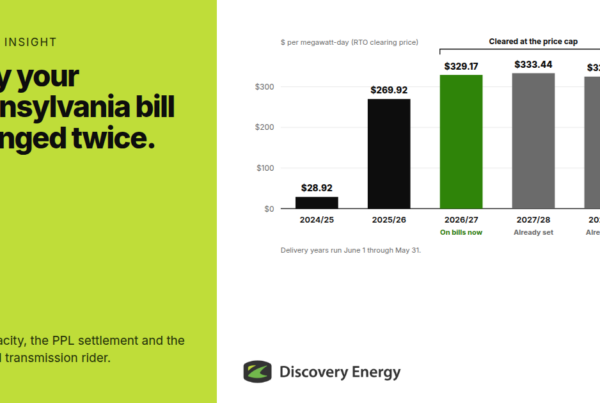
PJM side (Indiana Michigan Power). Facilities in northeastern Indiana are exposed to PJM's capacity market instead. PJM's 2026/2027 auction cleared at $329.17 per MW-day, and the 2027/2028 and 2028/2029 auctions also cleared at the price cap, so elevated PJM capacity pricing is set through May 2029.
| Market | Indiana utilities | 2026/2027 capacity price | How it reaches an industrial bill |
|---|---|---|---|
| MISO | AES Indiana, Duke Energy Indiana, NIPSCO, CenterPoint Energy Indiana | $424.30/MW-day summer (northern and central zones); about $116 to $126/MW-day annualized | Through each utility's tariff and trackers; for AES Indiana, Rider 24 reflects purchases beyond its own generation |
| PJM | Indiana Michigan Power (northeastern Indiana) | $329.17/MW-day; 2027/2028 and 2028/2029 also cleared at the price cap | Through Indiana Michigan Power's tariff |
The two markets run on different calendars, different auction designs, and different price paths. A multi-site Indiana portfolio cannot be budgeted with one capacity assumption. Each facility needs to be mapped to its utility and market first.
The base rate path is not finished
Rider 24 is only one channel. AES Indiana's base rates are also moving.
The 2026 rate order, in two phases
On June 17, 2026, the IURC approved an increase of about $71 million in AES Indiana's base rate case, IURC Cause No. 46258. The new rates take effect in two phases: the first on July 27, 2026, and the second in January 2027.
The case has been reopened
On September 2, 2026, the IURC voted 3-1 to reconsider the order and reopen the record to take new evidence on two developments: Google's planned data center in Monrovia and the pending acquisition of AES by a BlackRock-led consortium. The parties have agreed to a schedule that includes a one-day hearing in early March 2027.
According to the IURC, approved rates stay in effect unless a stay is granted, and are subject to refund if the order is later overturned.
For a manufacturer, this creates two separate planning issues:
- The January 2027 Phase 2 increase may take effect before the rehearing is resolved.
- Rider 24 and AES Indiana's other trackers can continue changing the bill independently of the rate-case outcome.
The result is a multi-step cost path. It is not one event that can be budgeted and closed.
A large-load case is running in parallel
In April 2026, AES Indiana filed a separate case asking the IURC to approve the generation and transmission investments needed to serve the Monrovia data center campus. According to AES's SEC filing, the service agreement with that customer includes financial assurances, minimum demand commitments, and exit provisions intended to protect existing customers.
The issue is broader than any one customer. It concerns who pays for new generation, transmission, and capacity when major loads are added. Existing industrial customers need to know whether new system costs are being assigned appropriately and whether their rate class is absorbing a disproportionate share.
HEA 1002 changes how future rate cases work
Indiana's HEA 1002 moves the state's five investor-owned electric utilities onto three-year multi-year rate plans with performance incentives tied to affordability and service restoration. Utilities begin filing those plans on a staggered schedule starting in 2026.
For manufacturers, the question is not only whether rates increase. It is how much cost moves into base rates, how much remains in trackers, and how quickly each component reaches the invoice. That makes invoice-level verification more important, not less.
Indiana has no supplier choice, which changes the playbook
Indiana's investor-owned electric utilities are vertically integrated. An AES Indiana facility cannot switch to a competitive electricity supplier, so there is no supply contract to renegotiate and no capacity pass-through clause to hedge. Capacity, energy, transmission, and distribution all arrive through the utility's approved tariff and trackers.
That shifts where an Indiana manufacturer can act:
- Billing accuracy: whether every tariff, rider, and determinant is applied correctly to each account.
- Rate schedule and options: whether each facility is on the right schedule and is using any interruptible, demand response, or other optional provisions the tariff offers.
- Operations: demand management that reduces billing determinants and ratchet exposure.
- Regulatory participation: industrial customers can take part in rate cases and tracker proceedings, directly or through industrial groups, which is where cost allocation is decided.
For multi-state organizations, facilities in deregulated states still need competitive procurement. Indiana sites need a different approach, and a single strategy has to account for both.
What an Indiana facility can actually do
Start with a utility audit.
The purpose is not simply to search for an obvious overcharge. It is to build a verified cost structure before making production, capital-planning, or regulatory decisions. A utility bill audit should examine the following.
-
Rate classification verification
Confirm that each Indiana facility is billed under the correct AES Indiana rate schedule. Industrial operations can be misclassified when production profiles, operating hours, ownership structures, or facility uses change. The wrong classification can affect demand charges, minimum charges, rider factors, and eligibility for optional provisions.
-
Rider 24 application and validation
Reconcile the Rider 24 charge to the applicable tariff, rate class, billing determinants, and effective dates. The review should confirm:
- The correct class factor is applied to each account.
- Factor changes take effect on the correct dates.
- The billed determinant agrees with the tariff.
- Reconciliations, credits, and prior-period true-ups are properly reflected.
- The charge is consistent across comparable facilities.
-
The other trackers
Rider 24 is one of several AES Indiana trackers. Others include fuel cost, MISO participation costs, environmental compliance, demand-side management, and off-system sales margins. Each has its own factor and schedule, and each should be checked against the tariff.
-
Demand ratchets and billing determinants
Demand ratchets can preserve a portion of a prior peak for future billing periods, so a facility that reduced production may still pay based on an earlier high-demand event. The audit should verify:
- Current and historical peak demand.
- Ratchet percentages and time periods.
- Coincident and non-coincident demand determinants.
- Power factor provisions.
- Meter multipliers.
- Transformation charges.
- Estimated versus actual readings.
-
Interval data review
Monthly bills show the result. Interval data helps explain the cause. Review interval usage against production schedules, shift changes, maintenance outages, weather, and system peak conditions. This can identify avoidable demand events and show whether load management or demand response has measurable financial merit.
Discovery Energy's utility bill audits are contingency-based. A review can cover rate classifications, tariffs, meter readings and multipliers, demand calculations, riders, and available government utility exemptions. There is no upfront audit fee. Under the agreed terms, Discovery Energy is paid when the client receives qualifying refunds, credits or realized savings.
Practical actions for Indiana energy managers
-
Audit before you budget
Establish the correct rate class, rider treatment, demand determinants, and historical baseline before building the 2027 budget.
-
Map the January 2027 and March 2027 timelines
Build scenarios for the Phase 2 increase, the rehearing outcome, and the next Rider 24 reset. Do not treat the current bill as a stable forward assumption.
-
Map every site to its utility and market
AES Indiana, Duke Energy Indiana, NIPSCO, and CenterPoint Energy Indiana sit in MISO; Indiana Michigan Power sits in PJM. Each has different tariffs, trackers, and capacity exposure.
-
Use the tools the tariff offers
Review interruptible, demand response, and other optional provisions, and manage the demand events that set billing determinants and ratchets.
-
Benchmark comparable Indiana facilities
Compare cost per kilowatt-hour, demand cost per kilowatt, rider charges, load factor, and peak timing across similar facilities. A single statewide average is not a sufficient benchmark.
-
Centralize bills, contracts, and interval data
Discovery Energy's TaraBase reporting platform consolidates bills, usage, contracts, savings, energy metrics, and ESG metrics into a single view, connecting the tariff finding to the budget and the operational response.
-
Coordinate Indiana with the rest of the portfolio
For facilities in deregulated states, use clear Buy, Wait, or Hedge guidance. Discovery's energy procurement process uses competitive RFPs, apples-to-apples bid comparisons, market timing, and contract tracking across deregulated markets.
FAQ: Indiana capacity riders and AES Indiana electricity costs
What is AES Indiana Rider 24?
Rider 24 is AES Indiana's Capacity Adjustment, an annual tracker that recovers or credits the difference between AES Indiana's capacity purchase costs and the amount built into base rates. The current tariff sheet was reissued effective July 27, 2026 under Cause No. 46258.
Does Rider 24 pass through PJM capacity prices?
No. AES Indiana operates in MISO, not PJM. Rider 24 reflects AES Indiana's capacity position in MISO, including any bilateral purchases or MISO auction purchases it needs beyond its own generation.
Which Indiana utilities are in PJM and which are in MISO?
Indiana Michigan Power, which serves northeastern Indiana, is in PJM. AES Indiana, Duke Energy Indiana, NIPSCO, and CenterPoint Energy Indiana are in MISO. Facilities in each territory face different capacity markets, prices, and tracker mechanics.
Why did my AES Indiana bill change if there was no new rate-case headline?
The change may be coming from Rider 24, another tracker, the first phase of the 2026 rate increase, a demand determinant, or a combination. A tracker can update a specific cost component without the same headline visibility as a rate case.
Can an Indiana facility avoid these charges by changing electricity suppliers?
No. Indiana does not offer retail electric choice, so AES Indiana customers buy all of their service from the utility. The levers are billing accuracy, rate schedule and tariff options, demand management, and participation in regulatory proceedings.
Does a utility audit only look for billing errors?
No. A utility audit examines rate classification, tariff application, riders, demand ratchets, meter multipliers, billing determinants, and available government utility exemptions. It also establishes a verified baseline for budgeting.
How can Indiana manufacturers prepare for January 2027?
Start with a historical utility bill audit. Then model the Phase 2 increase, the next Rider 24 reset, other trackers, and demand ratchets together. The goal is one verified cost model rather than separate assumptions held by facilities, finance, and procurement.
Can Discovery Energy manage the next steps after the audit?
Yes. Discovery Energy supports utility auditing, energy procurement for deregulated markets, bill pay and data collection, market reporting, and integrated reporting through TaraBase. The role is to provide a transparent, documented view of cost and risk across the portfolio.
Sources
- Indiana Office of Utility Consumer Counselor, AES Indiana Rates
- IURC, Order approving AES Indiana CAP and OSS adjustments for the 2025-2026 MISO planning year (June 2025)
- MISO, 2026 Planning Resource Auction results (April 2026)
- IURC, MISO presentation, Summer Reliability Forum (2026)
- PJM, 2028/2029 Base Residual Auction results (July 2026)
- Indiana Capital Chronicle, Utility panel greenlights reconsideration of AES Indiana hike (September 2026)
- Indiana Capital Chronicle, Review of $71 million AES Indiana rate hike to stretch into 2027 (September 2026)
- The AES Corporation, Form 10-Q, quarter ended June 30, 2026
- Taft, Summary of HEA 1002 provisions on performance-based ratemaking and multi-year rate plans (March 2026)
- Published by
- Discovery Energy
- Published
- October 2026
- Information current as of
- October 2026
The utility audit is the starting point because it turns an unexplained increase into a verified decision.
Indiana manufacturers do not need to predict every capacity auction to reduce financial exposure. They need to know which charges are on the bill, why they are there, whether they were applied correctly, and which portion can be managed through operations, tariff options, or the regulatory process.